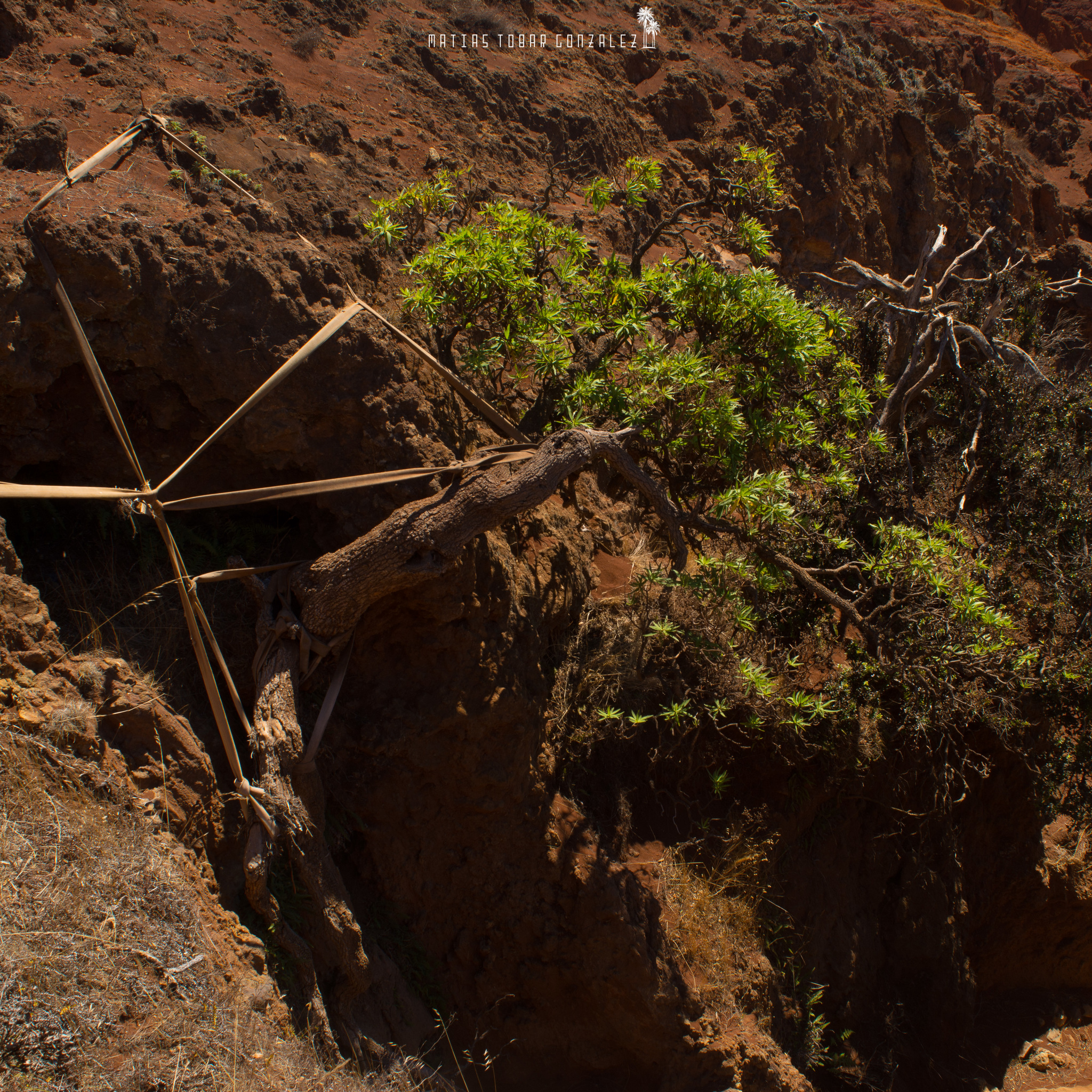
On the steep volcanic slopes of Robinson Crusoe Island, more than 700 kilometres off the coast of Chile, a small tree grows from a cliff.
At first glance, it may not look like one of the most extraordinary trees on Earth. Its branches reach out above the Pacific. Its roots hold to the rock. Ropes help keep its trunk from falling.
But there is something that makes this particular tree almost impossible to comprehend:
There are no others like it left in the wild.
It is Dendroseris neriifolia, a Critically Endangered species found naturally only in Chile's Juan Fernández Islands. This single tree is its last known wild representative.
A tree that has nowhere left to go
The Juan Fernández archipelago lies around 760 kilometres from mainland Chile. That distance matters. Long isolation in the Pacific allowed an unusual flora to evolve there, and around 65 per cent of the islands' plant species occur nowhere else on Earth.
Among them is Dendroseris, a genus sometimes known as the cabbage trees. These are tree daisies: relatives of familiar daisies that, in the island environment, evolved woody trunks, branches and crowns of flowers.
Dendroseris neriifolia once grew in the ravines and lower areas of Robinson Crusoe Island. By 1980, only eight wild plants were known to remain.
Forest clearance and grazing by introduced mammals reduced its habitat. Invasive plants suppressed the native vegetation, while repeated fires made an already vulnerable landscape less secure. Recovery efforts began, but reintroduced plants did not establish a lasting new population.
Eventually, eight became one.
Collecting seeds from a cliff
Even reaching the last tree is difficult.
It grows on the side of a steep cliff and is supported with ropes to prevent it from falling. When its fruits mature in March, conservationists climb along the trunk towards the flowering branches. Nets placed around them catch the mature seeds.
The location is not the only difficulty. According to the Royal Botanic Gardens, Kew, around 90 per cent of the tree's seeds are non-viable. Isolation has left it with extremely poor reproductive success.
That makes every seed with a living embryo unusually precious.
In the conservation effort reported by Kew in May 2026, collectors gathered 400 seeds. Twenty-nine travelled from Chile to Kew's Millennium Seed Bank at Wakehurst in England.
X-ray analysis suggested that 25 of those 29 seeds might contain viable embryos.
Then some of them began to grow.
Eight small beginnings
Kew used eight seeds in germination and cultivation trials.
All eight germinated.
It is a tiny number. Set beside one remaining tree in the wild, it feels enormous.
The seedlings are being grown so researchers can learn which conditions will help them survive, reach maturity and eventually produce seeds of their own. Three are intended for Logan Botanic Garden in southwest Scotland, whose mild climate has proved suitable for other plants from the Juan Fernández Islands.
The remaining seed material will be kept in long-term storage at the Millennium Seed Bank. It is a safeguard against the species disappearing in the wild or being lost during cultivation.
There is already one young Dendroseris neriifolia growing at VerdeNativo Botanic Garden in Chile. But cultivated plants are not the emotional endpoint of this story. The larger hope is to learn enough—and preserve enough living material—to give the species a secure future.
What does it mean to be the last tree?
Extinction is usually described through numbers.
Populations fall by percentages. Habitats disappear by hectares. Species move between categories on conservation lists.
This tree turns that abstraction into something physically understandable.
There is a cliff.
There is a trunk held by ropes.
There are branches that flower above the Pacific.
And, in the wild, there is one.
Perhaps that is why an individual tree can tell an environmental story differently from a forest.
A forest asks us to understand a system.
A single tree asks us to meet an individual.
On Robinson Crusoe Island, that individual is still holding on. For the moment, it is the last.
But eight tiny seedlings suggest that it may not always have to be.
Photo: Matías Tobar González (matamataag), via iNaturalist and Wikimedia Commons. Published under the CC0 1.0 Universal Public Domain Dedication.
