Three years after Sycamore Gap was felled, a ring of shoots is rising from the stump. Regrowth is not the same as restoration.
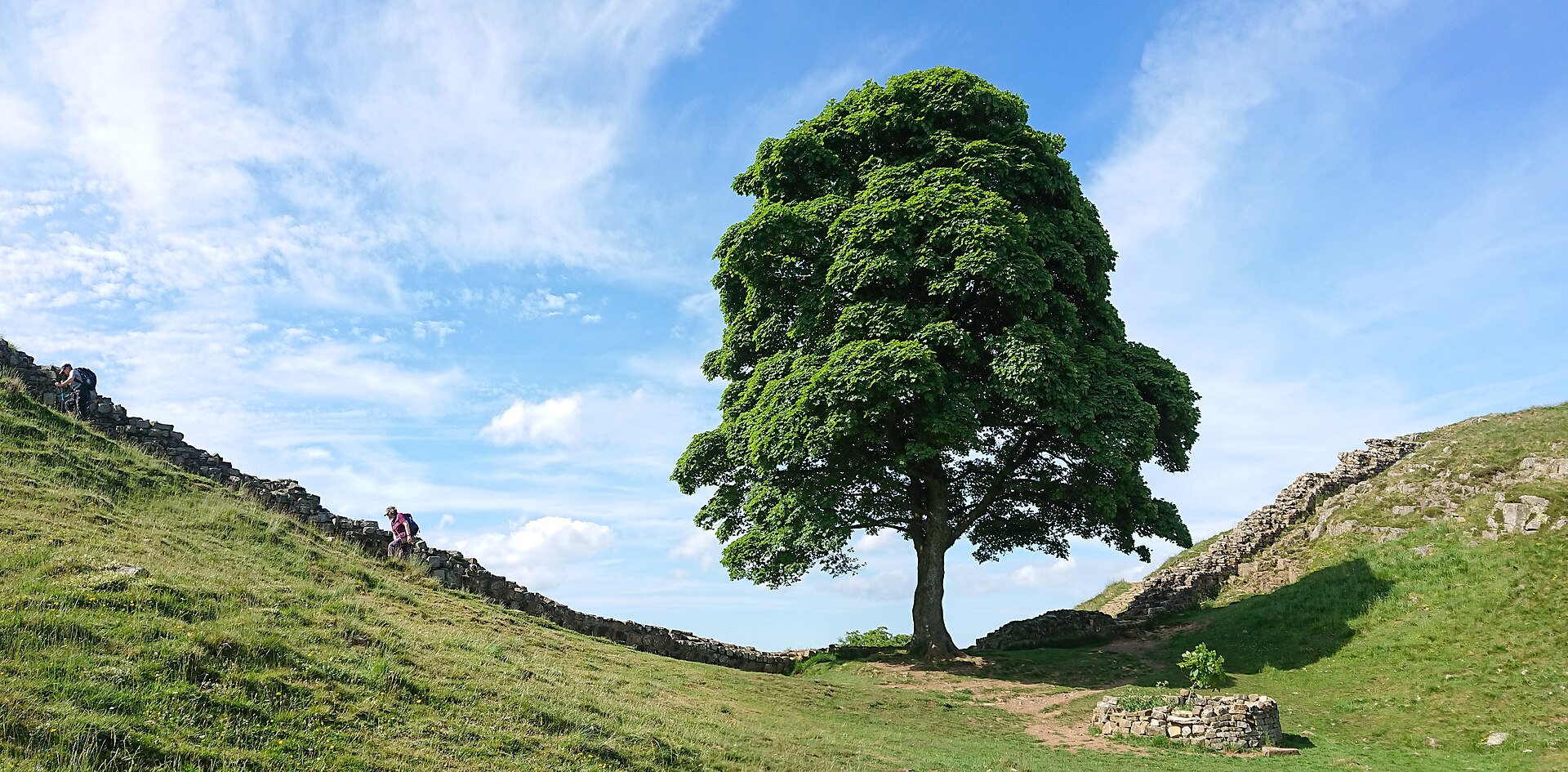
The famous tree is still gone. Its single crown no longer fills the dip in the land beside Hadrian’s Wall. The clean silhouette that made Sycamore Gap instantly recognisable was destroyed in one night.
But around the stump, something smaller has appeared: a ring of green shoots, some two to three feet high.
On 28 September 2026, three years after the illegal felling, the National Trust published new images of growth emerging from the base. They do not show the old tree returning. They show that its roots are alive.
Life below the cut
When a broadleaf tree loses its trunk, dormant buds near the base can sometimes break into growth. Stored energy and an established root system support new stems. The process resembles coppicing, the ancient practice of cutting trees low so that multiple shoots regenerate from the stool.
Sycamore, Acer pseudoplatanus, is capable of vigorous regrowth. Yet possibility is not certainty. New shoots are vulnerable to browsing, trampling, drought and competition. A mature root system also has to adjust to the abrupt loss of the crown that once supplied it with sugars.
That is why the ground matters. Rangers have kept protective fencing around the stump and managed access to reduce compaction and disturbance in the root zone. The future form of the growth will be decided later: several stems might be retained, or one may eventually be selected. For now, monitoring is a form of restraint.
The shape that was lost
Sycamore Gap was more than a living sycamore. It was one trunk precisely placed in a dramatic cleft, held between slopes and beside the line of Hadrian’s Wall. People recognised the relationship before they recognised the individual parts.
New stems can preserve biological continuity. They cannot recreate that mature architecture on demand. Even if one shoot becomes a large tree, it will take decades to make a new silhouette, and it will carry the structure of injury within it.
To call the regrowth a happy ending would flatten the loss. The original trunk and canopy are irretrievable. The landscape people knew was deliberately altered. Recovery does not reverse the act; it begins after it.
The same tree, changed
Trees complicate the language of death. We often imagine an individual as a single visible body, but much of a tree lives out of sight. Roots, stored carbohydrates and dormant buds can outlast catastrophic damage above ground. A stump may look like the end while still containing the means to continue.
Is the ring of shoots the same tree? Genetically and physically, they arise from the surviving organism. Visually, they are nothing like the landmark. Culturally, they will always be understood through the absence beside them.
All three statements can be true.
The strongest response to the new growth is not to turn it into a miracle. It is to see exactly what is there: persistence measured in feet, protected by a fence, without guarantees. The shoots are not replacements for what was destroyed. They are the tree’s answer to it.
For years, visitors looked toward Sycamore Gap and saw one unmistakable crown. Now the eye must learn to look lower, at a cluster of leaves close to the cut, where the future is beginning without pretending the past has returned.
Trees I Saw is an observation project about trees, places and the stories that gather around them — treesisaw.com.
Sources
- National Trust: new pictures show Sycamore Gap in recovery
- ITV News: ring of shoots three years after the felling
Photo: Gordon Leggett, Wikimedia Commons, CC BY-SA 4.0. Photographed in 2018, before the felling.